
Armadillos
Everything You Need to Know
There are 20 species of armadillos, grouped in nine
genera and distributed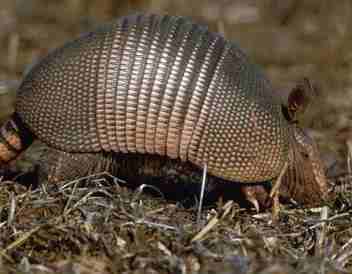 through America from Argentina to the
south-eastern corner of the United States.
through America from Argentina to the
south-eastern corner of the United States.
The best-known is the nine-banded armadillo that ranges northwards from South America into Kansas and Missouri in the United States. It has been studied in detail because it is of economic importance, eating eggs, undermining buildings, and starting erosion on the one hand, but on the other it kills undesirable insects and snakes.
 The largest
is the giant armadillo of the forests of eastern South America which has a 3 ft body and
can weigh as much as 130 pounds. It is unusual in having up to a hundred small teeth, more
than twice the normal complement for a mammal. The naked-tailed armadillos of central and
southern America have five large claws on the front feet. The middle claw is especially
large and sickle-shaped. The three-banded armadillo or apara, of Bolivia, Matto Grosso,
Argentina and Brazil is the only one able to roll up, and the seperation of the armor from
the skin means there is room for the head, legs and tail when it does so.
The largest
is the giant armadillo of the forests of eastern South America which has a 3 ft body and
can weigh as much as 130 pounds. It is unusual in having up to a hundred small teeth, more
than twice the normal complement for a mammal. The naked-tailed armadillos of central and
southern America have five large claws on the front feet. The middle claw is especially
large and sickle-shaped. The three-banded armadillo or apara, of Bolivia, Matto Grosso,
Argentina and Brazil is the only one able to roll up, and the seperation of the armor from
the skin means there is room for the head, legs and tail when it does so.
The fairy armadillo of the plains of western
Argentina is a strange creature. It has less armor than the
other species. The armor is made up of bands hinged together and covering the back only.
Attachment to the body is limited to a narrow ridge of flesh running down the spine. There
is another flat shield consisting of a single plate covering the rump; the armored tail
sticks through this. The rest of the body is covered with a fine, soft, white fur. The
fairy armadillo is mole-like, having powerful front legs, and small eyes. It spends more
time underground than other armadillos.
has less armor than the
other species. The armor is made up of bands hinged together and covering the back only.
Attachment to the body is limited to a narrow ridge of flesh running down the spine. There
is another flat shield consisting of a single plate covering the rump; the armored tail
sticks through this. The rest of the body is covered with a fine, soft, white fur. The
fairy armadillo is mole-like, having powerful front legs, and small eyes. It spends more
time underground than other armadillos.
The pygmy armadillo, pichi, or pichiciego, that lives in Patagonia and the Argentine pampas, is said to hibernate, but there has been no confirmation of an early report on this habit.
